Dow Jones Industrial Average
The Dow Jones Industrial Average tracks 30 prominent blue-chip companies listed on U.S. stock exchanges. It is one of the oldest and most-watched indices in the world.
The most striking divergence in seasonal data for the Dow right now sits between two competing frameworks. The last 10 consecutive years show a 90-day win rate of 100%, with every single instance finishing positive and an average gain of 3.99%, projecting a target near 57,481. Midterm election years tell a sharply different story: a 90-day win rate of just 72.2% with an average return of only 0.25%, targeting 46,994, representing a 7.42% decline from current levels.
Midterm years historically introduce meaningful volatility into the Dow, with worst-case 90-day drawdowns reaching 22.44%. The near-term 30-day midterm win rate of 61.1% signals choppy conditions ahead. Investors should watch whether the strong recent momentum sustains or midterm election-cycle pressure reasserts itself through summer.
Seasonal Price Projections
Select a historical basis and projection horizon to see where seasonal patterns suggest Dow Jones Industrial Average may be headed.
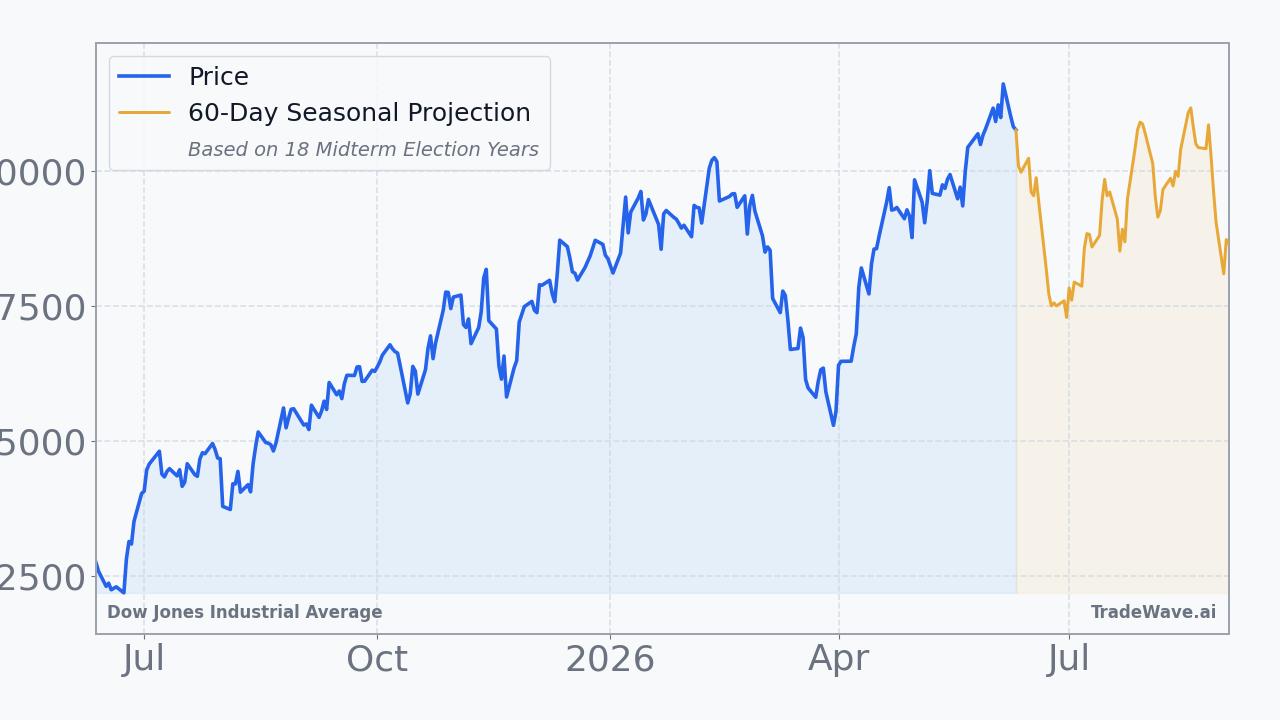
Projection as of Jun 12, 2026 from closing price $50,848.75
How to Use This Data
Seasonal projection data for the Dow Jones Industrial Average shows how the index has historically performed during this same calendar period across prior years. The consecutive pattern carries an 80.0% win rate, meaning the Dow finished higher in 80.0% of those historical instances, with an average return of +3.5%.
The two bases here point in opposite directions, which is worth noting. The consecutive pattern projects +14.0%, while the midterm election year pattern projects -4.2%, reflecting a 44.4% win rate during those specific cycles. The median return of -0.7% for midterm years may be more informative than the average, since medians are less distorted by a small number of extreme outcomes.
Historical patterns cannot account for breaking news, Federal Reserve decisions, earnings surprises, geopolitical developments, or sudden shifts in investor sentiment. Even an 80.0% win rate leaves a meaningful probability of a down period, and no seasonal projection guarantees any specific outcome in any given year.
Seasonal data functions as one lens among many. Market participants often weigh it alongside fundamental analysis, technical indicators, and broader macroeconomic context. When two bases diverge as they do here, that divergence itself is useful information, signaling that historical conditions have not been uniform and that outcomes have varied depending on the broader cycle.
This information is provided for educational purposes only and does not constitute financial advice, a recommendation, or a solicitation to buy or sell any security. Seasonal patterns are based on historical data and do not guarantee future performance. All investment decisions carry risk. Consult a qualified financial advisor before making investment decisions.
Understanding Seasonal Projections
Seasonal projections estimate future price movement based on how Dow Jones Industrial Average has historically performed during the same calendar period. These are statistical baselines derived from decades of market data, not predictions.
Consecutive Years (Last 10)
Uses the most recent 10 years of data regardless of market regime. This captures the broadest recent behavior, including all economic and political environments. Over the next 60 trading days, this pattern has been positive 8 of 10 times with an average return of +3.5%.
Midterm Election Years (18 Available)
Uses only years that fall in the same position within the 4-year U.S. presidential election cycle. 2026 is a midterm election year. Markets often exhibit distinct patterns tied to fiscal and monetary policy shifts within this cycle. In 18 historical midterm election years, this 60-day window was positive 8 times with an average return of -0.2%.
Seasonal patterns reflect historical tendencies and do not guarantee future results. All projections are based on past performance and should be used as one input among many in your investment decision-making process. Data provided by TradeWave.ai.
Latest News
Recent headlines related to Dow Jones Industrial Average, sourced from major financial news outlets with AI sentiment analysis.
- Gap and Sally Beauty Stocks Trade Up, What You Need To Know
- Dow Jones Futures: SpaceX IPO To Launch After Trump Market Rally
- OneWater, CarMax, and Dillard's Shares Skyrocket, What You Need To Know
- Why Target (TGT) Stock Is Up Today
- America's Car-Mart, Kohl's, and Macy's Shares Are Soaring, What You Need To Know
- Dow Jones Futures: Techs Rise After Big Trump Rally; SpaceX IPO To Launch
- Boot Barn, Ollie's, and Williams-Sonoma Shares Are Soaring, What You Need To Know
- Burlington, Victoria's Secret, and Genuine Parts Shares Skyrocket, What You Need To Know
- Abercrombie and Fitch and Urban Outfitters Shares Are Soaring, What You Need To Know
- Review & Preview: Strike That
Explore More
Other markets with seasonal analysis and recent pattern articles.